Pages

Showing posts with label Stage-of-life-weathering. Show all posts

Thursday, February 25, 2021

Physico-chemical-weathering

Chemical stage 1: Base coat, e.g. dark green from Tamiya.
Use colors with acrylic resins like Tamiya and Zero Paint.
Make tests of the described procedure prior to paint your model!

Chemical stage 2: Apply a thick coat of hairspray
and let it stay for 30 secs. Then rise with warm water.
The alcohols and solvents in the hairspray will
chemically alter the base coat. See change of color between
the upper 2 pictures!


Physical stage 1+n: Carefully treat the surface with
tools like wooden chisels. Be careful not to score comletely
through the paint work when using metal tools!

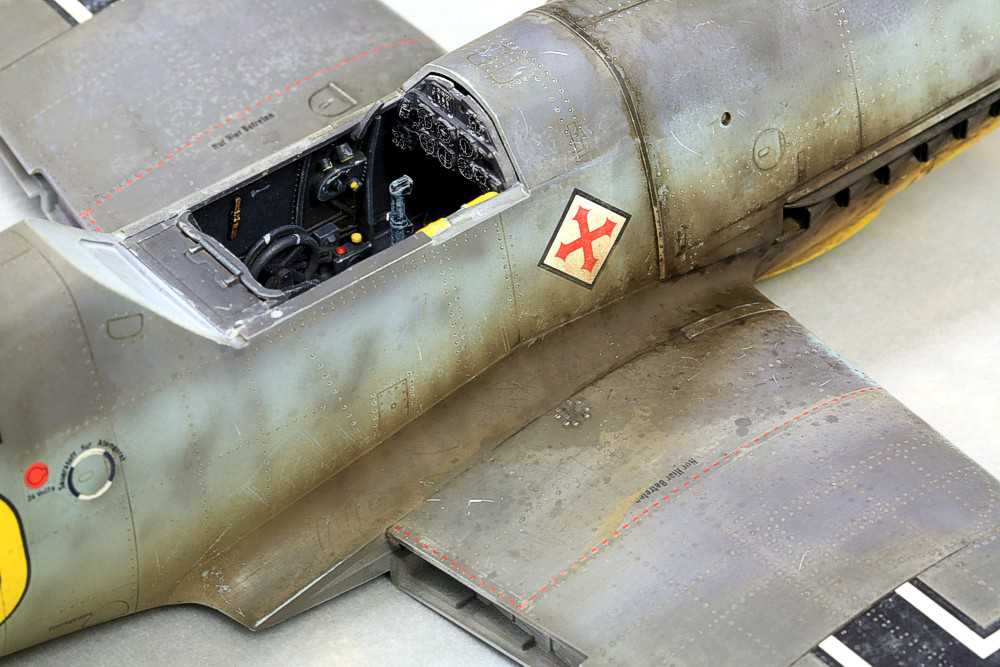
Rub, score, scratch and strike the surface till it looks worn and used. Apply chipping with songes, straight scratches with a curved blade dipped into thin paint. Apply panel washes before applying the hairspray. Add sprinkels and more washes as desired. Add streaking effects by airbrush using heavily diluted Tamiya flat black and redbrown.


Wednesday, January 27, 2016

Weathering concepts: Stage-of-life-weathering | Part One

Weathering in scale modeling

A first try of a concept of mine

All scale modelers have to deal with scaling effects and problems: we are building miniatures and replicas of real things and try to make them looking »real«. A vast number of techniques have been developed by talented modelers and several different schools have developed from »artistical« to »realistic«, from »northern« to »southern« schools.

My ideal replica looks both realistic and artistcal. I have an scientific education and I have an interest in regularities and processes. So, when studying authentic photos of, e.g. a Bf109, I try to »read« the history of that Bf109 like I try to read the history of a rock or fossil as a geologist.

The history of each modeling subject can be split in successive life stages determined by the circumstanes of its nature and operation. The life stages are also influenced by regularities that have their origin in operational and technical reasons as well as in nature itself.

The following diagram shows a succession of life stages for a given modeling subject, e.g. a WWII fighter aircraft. The dark blue spiral shows the time line and evoluton of the single life stages (orange-red boxes). Over its entire life span this aircraft is subject to several specific processes (see light blue boxes), e.g. formation and interim removal of exhaust stains. All these different processes can be contemporary and effective over the entire life time resulting in a complex and interleaved finish where several generations or layers of exhaust stains, oil streaks, dirt and grime, paint chippings and many more are present.

I think this results in a »realistic« and »artistical« replica that has a story to tell!


First try: Stage-of-life weathering

Interleaved finish of several generations of exhaust stains,
oil stains, dust, dirt, scratches and scuff markings.

Most effects like exhaust stains are made of
several generations of application, partial removal
and re-application to recreate the life stages
and processes that occured in the life time
of the original subject.